
Platform-as-a-Service
While reliable and powerful, IaaS products’ focus is on providing the resources for deployment. Choices about configuring, connecting, and deploying these resources are left to the user. Making those choices can require domain-level expertise. These issues reintroduce previous concerns, requiring engineers with specific knowledge of the cloud service provider for successful deployment.
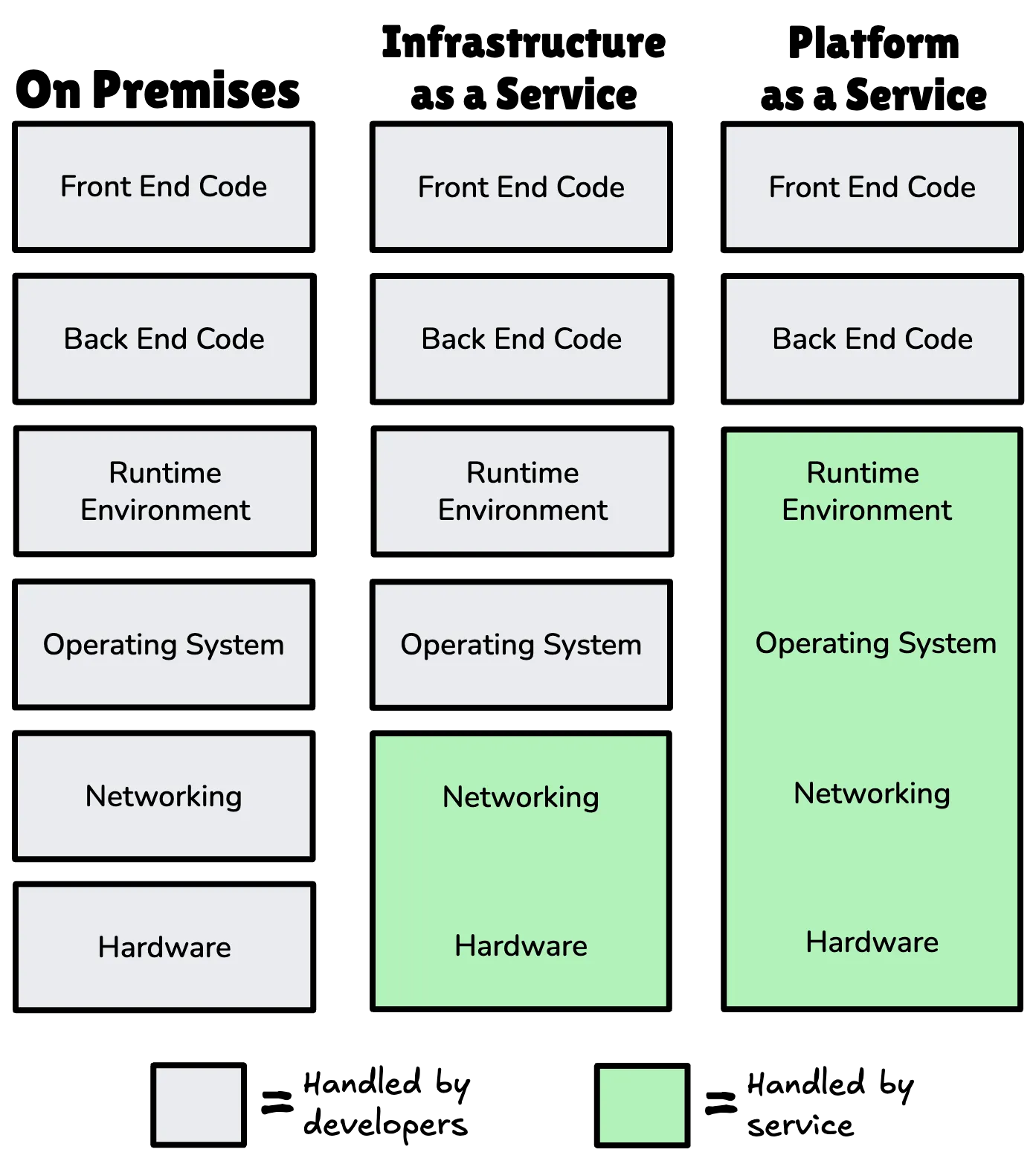
PaaS solves these issues by abstracting deployment further. Whereas IaaS provides computing resources and leaves the rest to developers, PaaS also handles higher layers such as operating systems and runtime environments. Thus, teams are left to focus solely on application code. This can be a cost-effective solution, as it removes the need for operations teams to monitor infrastructure and developers can instead prioritize working on core business logic.
Some notable PaaS providers are Heroku, Vercel, Netlify, and Fly.io.
Redeployment
Section titled “Redeployment”Software applications are not just built and deployed once. Bug fixes are implemented, features are added, changes are made to maintain compatibility with other programs, etc. Redeployment can involve rebuilding Docker images and switching network traffic from an old server instance to the new version.
Developers want a streamlined process for this. PaaS products can set the redeployment process such that changes to an application automatically trigger redeployment. For applications deployed directly on IaaS, such as Amazon Web Services (AWS), there is no such one-size-fits-all redeployment. Developers can create a manual solution or set up (and pay for) services such as AWS‘s own CodePipeline and CodeBuild.
Problems with Platform as a Service
Section titled “Problems with Platform as a Service”Providing a Platform as a Service product comes with a myriad of decisions and potential issues. Once you abstract the complexity of infrastructure deployment away from the user, you begin making decisions for the user about that infrastructure. The service provider decides what is important for the user to see, utilize, deploy, and pay for. Deployment teams may require greater transparency into and direct access to their resources.
Cost savings from freeing up developer time may be outweighed by the price markup compared to a less managed service. For instance, serverless functions on Vercel, which are built on top of AWS Lambda serverless functions, cost $0.60 per million requests compared to $0.20 per million requests on AWS Lambda. 2 This markup resulted in one developer racking up $96,280 in a few days when their app Cara went viral. 3
Developers looking for lower costs as well as more direct control and observability into their resources need another solution.
PaaS-lite
Section titled “PaaS-lite”We call PaaS solutions that preserve users’ control of and observability into underlying infrastructure “PaaS-lite”.
One PaaS-lite solution is Flightcontrol (flightcontrol.dev), a commercial Platform as a Service that deploys to the user’s AWS account. Users can still directly access their AWS resources manually, unlike with full PaaS solutions. Flightcontrol (FC) charges some management fees but with no markup on the infrastructure bills, which the user pays directly to AWS. Users connect their GitHub repo, answer some questions about what their project is, and connect their AWS account to FC. After that quick setup, FC deploys the user’s project, displaying high-level monitoring and configurations via dashboard. Because all AWS resources are deployed into the user’s account and easily accessible, users retain direct control over their cloud infrastructure.
Flightcontrol is highly configurable, provides direct customer support, and includes a free tier for single users. However, its code is proprietary and the free tier lacks support for GitHub Organizations. This leaves space for an open source PaaS-lite product that is aimed at small teams looking to deploy more easily to their own AWS account.
2 Vercel: https://vercel.com/docs/functions/usage-and-pricing AWS Lambda: https://aws.amazon.com/lambda/pricing/
3 https://techcrunch.com/2024/06/06/a-social-app-for-creatives-cara-grew-from-40k-to-650k-users-in-a-week-because-artists-are-fed-up-with-metas-ai-policies/